
Smart Industrial 100MPa Range Hart liquid oil gas Chemical Pipeline pressure Sensor Transmitter
- Home
- Smart Industrial 100MPa Range Hart liquid oil gas Chemical Pipeline pressure Sensor Transmitter
Smart Industrial 100MPa Range Hart liquid oil gas Chemical Pipeline pressure Sensor Transmitter
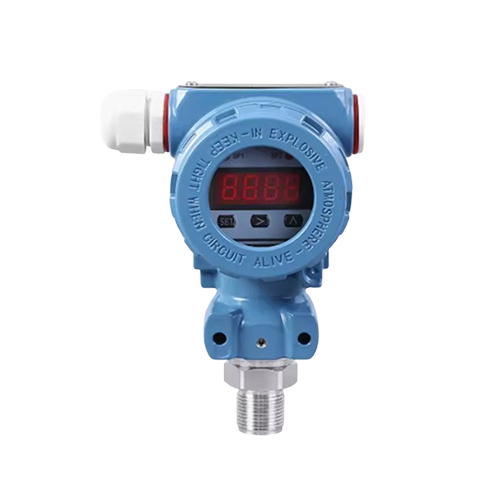
Key Features
Wide Pressure Range
• Measures from very low vacuum pressure to high pressure
High Accuracy & Precision
• Typical accuracy: ±0.5% Full Scale (FS)
Multiple Pressure Types Supported
• Gauge Pressure
• Absolute Pressure
• Differential Pressure
• Absolute Pressure
• Differential Pressure
Robust Construction
• Stainless steel (SS316/SS304) body
• Corrosion resistant and long service life
• Corrosion resistant and long service life
Temperature Compensation
• Built-in compensation reduces error due to temperature variation
Fast Response Time
• Suitable for dynamic and real-time pressure monitoring
Analog & Digital Outputs
• 4–20 mA
• 0–5V / 0–10V
• HART, Modbus protocols
• 0–5V / 0–10V
• HART, Modbus protocols
High Stability & Reliability
• Long-term drift typically ≤ ±0.5% FS/year
Compact & Easy Installation
• Threaded connections (1/4" NPT, BSP)
• Quick and simple mounting
• Quick and simple mounting
Overpressure Protection
• Withstands pressure spikes without damage
Low Power Consumption
• Ideal for battery-operated and remote applications
EMI/RFI Protection
• Resistant to electrical noise in industrial environments
Working Principle
1. Basic Working Concept
When pressure is applied to a sensor:
➡️ It acts on a sensing element (diaphragm)
➡️ The diaphragm deforms (deflects)
➡️ This deformation is converted into an electrical signal
2. Main Components
1. Sensing Element (Diaphragm)
- Thin metallic or silicon membrane
- Deforms under applied pressure
- Common materials: Stainless Steel, Silicon, Ceramic
2. Transduction Element
Converts mechanical deformation into an electrical signal.
Types:
- Strain Gauge (most common)
- Capacitive
- Piezoelectric
- Piezoresistive
3. Signal Conditioning Circuit
- Amplifies weak signals
- Converts into standard output signals like:
- 4–20 mA
- Voltage output
3. Step-by-Step Working
Step 1: Pressure Application
- Process pressure (P) is applied through a sensor port
Step 2: Diaphragm Deflection
- Pressure causes the diaphragm to bend
- Deflection is proportional to applied pressure
4. Common Working Mechanisms
✅ A. Strain Gauge Type (Most Widely Used)
- Strain gauges are mounted on the diaphragm
- When deformation occurs:
- Length and cross-section change
- Electrical resistance changes
Principle:
R = ρ (L / A)
- Change in resistance is very small
- Measured using a Wheatstone Bridge
Output:
- Resistance change → Converted into voltage signal
✅ B. Capacitive Pressure Sensor
- Uses two plates:
- One fixed
- One movable (diaphragm)
Principle:
C = ε (A / d)
- Pressure change alters distance (d)
- Capacitance changes accordingly
✅ C. Piezoelectric Pressure Sensor
- Uses crystals like Quartz
Working:
- Pressure generates electric charge directly
Best For:
- Dynamic pressure measurement
- Vibrations and pulsations
✅ D. Piezoresistive (Silicon) Sensor
- Silicon diaphragm with embedded resistors
- Pressure → Stress → Resistance change
Key Feature:
- Very high sensitivity
5. Signal Conversion Process
- Pressure → Mechanical deformation
- Deformation → Electrical change (Resistance / Capacitance / Charge)
- Electrical change → Amplified signal
- Output → Standard industrial signal
6. Output Signals
Typical outputs include:
- 4–20 mA (industry standard)
- 0–10 V / 0–5 V
- Digital outputs (HART / Modbus)
7. Types of Pressure Measurement
✔ Gauge Pressure
- Measured relative to atmospheric pressure
✔ Absolute Pressure
- Measured relative to vacuum
✔ Differential Pressure
- Difference between two pressure points
Industrial Applications
Oil & Gas Industry
• Pipeline pressure monitoring
• Wellhead pressure measurement
• Tank and vessel pressure control
• Compressor & pump monitoring
• Wellhead pressure measurement
• Tank and vessel pressure control
• Compressor & pump monitoring
Chemical & Petrochemical Plants
• Reactor pressure control
• Process safety monitoring
• Corrosive fluid pressure measurement
• Filtration system pressure
• Process safety monitoring
• Corrosive fluid pressure measurement
• Filtration system pressure
Water & Wastewater Treatment
• Pump pressure monitoring
• Filter clogging detection
• Pipeline pressure measurement
• Level measurement using hydrostatic pressure
• Filter clogging detection
• Pipeline pressure measurement
• Level measurement using hydrostatic pressure
Power Plants
• Boiler pressure monitoring
• Steam pressure control
• Turbine pressure supervision
• Condenser vacuum measurement
• Steam pressure control
• Turbine pressure supervision
• Condenser vacuum measurement
HVAC Systems
• Air duct pressure monitoring
• Filter condition monitoring
• Refrigerant pressure measurement
• Cleanroom pressure control
• Filter condition monitoring
• Refrigerant pressure measurement
• Cleanroom pressure control
Manufacturing & Automation
• Hydraulic system pressure
• Pneumatic system control
• Machine safety systems
• Injection molding pressure control
• Pneumatic system control
• Machine safety systems
• Injection molding pressure control
Food & Beverage Industry
• Hygienic pressure measurement
• CIP/SIP system monitoring
• Tank and vessel pressure
• Pasteurization process control
• CIP/SIP system monitoring
• Tank and vessel pressure
• Pasteurization process control
Pharmaceutical Industry
• Sterile process pressure monitoring
• Cleanroom differential pressure
• Bioreactor pressure control
• GMP compliant operations
• Cleanroom differential pressure
• Bioreactor pressure control
• GMP compliant operations
Automotive Industry
• Engine oil pressure monitoring
• Fuel system pressure
• Tire pressure monitoring (TPMS)
• Brake system pressure
• Fuel system pressure
• Tire pressure monitoring (TPMS)
• Brake system pressure
Aerospace & Aviation
• Cabin pressure monitoring
• Hydraulic system pressure
• Fuel system pressure
• Environmental control systems
• Hydraulic system pressure
• Fuel system pressure
• Environmental control systems
Marine & Ship Industry
• Ballast tank pressure
• Engine and fuel pressure
• Hydraulic control systems
• Engine and fuel pressure
• Hydraulic control systems
Mining Industry
• Slurry pipeline pressure
• Hydraulic equipment monitoring
• Dust suppression systems
• Hydraulic equipment monitoring
• Dust suppression systems
Energy & Renewable Sector
• Wind turbine hydraulic pressure
• Solar thermal system pressure
• Gas distribution systems
• Solar thermal system pressure
• Gas distribution systems
Technical Specifications
| Parameter | Specification |
|---|---|
| Measurement Type | Gauge / Absolute / Differential |
| Pressure Range | Confirm at the time of order |
| Accuracy | ±0.5% FS |
| Output Signal | 4–20 mA, 0–5 V, 0–10 V, Digital (HART/Modbus) |
| Supply Voltage | 12–36 V DC (typical 24 V DC) |
| Response Time | ≤ 1 ms to 100 ms |
| Overpressure Limit | 1.5 to 3 times of full scale |
| Burst Pressure | 3 to 5 times of full scale |
| Long-term Stability | ±0.1% FS/year |
| Repeatability | ±0.05% FS |
| Hysteresis | ±0.05% FS |
| Temperature Range (Operating) | -20°C to +80°C |
| Compensated Temperature Range | -10°C to +70°C |
| Process Temperature | Up to 120°C (with cooling option higher) |
| Temperature Effect (Zero/Span) | ±0.02% FS/°C |
| Wetted Parts Material | SS316 / SS304 / Ceramic |
| Housing Material | Stainless Steel / Aluminum |
| Protection Class | IP65 / IP67 / IP68 |
| Electrical Connection | DIN Connector / Cable / M12 |
| Process Connection | 1/4" NPT, 1/2" NPT, BSP Thread |
| Mounting Type | Direct / Panel / Inline |
| Insulation Resistance | ≥100 MΩ @ 500 V DC |
| Media Compatibility | Liquid, Gas, Steam (depending on material) |
| Ingress Protection | Dust-tight & water-resistant |
| Certification (Optional) | CE, ATEX, ISO |
| Weight | 150 g to 500 g (approx.) |