
Thermal Mass Flow Meter
- Home
- Thermal Mass Flow Meter
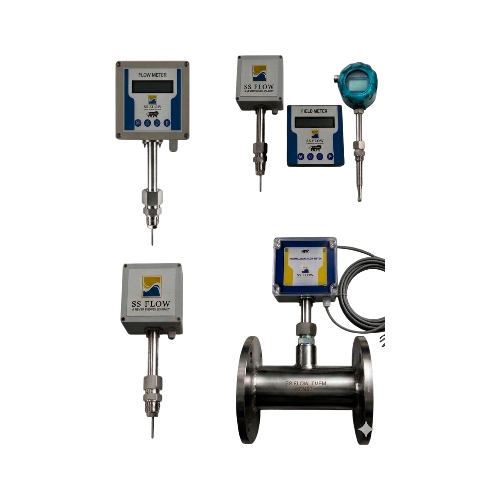
Thermal Mass Flow Meter
The working principle of a thermal mass flow meter is based on the concept of convective heat transfer. The flow meter consists of a heated element (often referred to as a sensor or probe) and temperature sensors. These sensors are usually located upstream and downstream of the heater. The heater continuously maintains a constant temperature difference (AT) relative to the fluid. As the fluid flows past the heated element, it absorbs heat due to convective heat transfer. The temperature sensors measure the temperature difference (AT) between the heated element and the fluid. This temperature difference is directly proportional to the rate at which heat is carried away by the fluid, which in turn correlates with the mass flow rate of the fluid. By knowing the heat input (power supplied to the heater) and monitoring the temperature difference (AT), the mass flow rate of the fluid can be calculated using specific calibration factors and the physical properties of the fluid (such as thermal conductivity and specific heat). The flow meter processes this data to provide an output signal that directly indicates the mass flow rate of the fluid.
Key Features
Wide Range of Applications
• Suitable for a wide range of industrial applications
Easy Installation & Maintenance
• Easy installation and maintenance
Weatherproof / Flameproof Enclosure
• Weatherproof or flameproof enclosure as per requirement
SS 316 Vibrating Fork
• SS 316 vibrating fork designed to withstand harsh environments
No Moving Parts
• No moving parts, ensuring no mechanical wear and tear
Adjustable Differential Time Delay
• Adjustable differential time delay with ON/OFF timing
Fail Safe High / Low Selection
• Field-configurable fail-safe High/Low selection feature
Industrial Applications
Oil & Gas Industry
Reliable measurement and monitoring solutions for oil and gas processing applications.
Chemical & Petrochemical Plants
Robust solutions for chemical processing and petrochemical plant applications.
Power Plants
Reliable measurement and monitoring solutions for power generation systems.
Steel & Metallurgy Industry
Durable solutions for steel production, metal processing and metallurgical applications.
Pharmaceuticals & Biotechnology
Precision solutions for pharmaceutical, biotechnology and process applications.
Food & Beverage Industry
Hygienic and reliable solutions for food and beverage processing applications.
Cement Industry
Robust solutions for cement manufacturing, processing and material handling applications.
Water & Wastewater Treatment
Efficient measurement and monitoring solutions for water and wastewater treatment systems.
Semiconductor & Electronics Industry
Precision measurement solutions for semiconductor and electronics manufacturing applications.
General Industrial Utilities
Reliable solutions for general industrial utility and process applications.
Line Size with Flow Range
| Line Size (mm) | Flow Range (M3/Hr) – Upto 40 m/s | Flow Range (M3/Hr) – Upto 100 m/s |
|---|---|---|
| 15 | 26 | 65 |
| 20 | 46 | 115 |
| 25 | 70 | 175 |
| 32 | 117 | 290 |
| 40 | 180 | 1800 |
| 50 | 280 | 700 |
| 65 | 480 | 1200 |
| 80 | 720 | 1800 |
| 100 | 1130 | 2800 |
| 125 | 1760 | 4500 |
| 150 | 2500 | 6500 |
| 200 | 4500 | 11500 |
Technical Specifications
| Parameter | Specification |
|---|---|
| Performance Structure Type | Insertion / In-Line |
| Measuring Medium | Common steady-state gases (unstable media such as acetylene and boron trichloride are not measurable) |
| Pipe Diameter Range | DN65–4000 mm (Insertion) / DN15–Please Consult Factory (In-Line) |
| Flow Rate Range | 0.1–120 Nm/s |
| Accuracy | ±1.5% |
| Operating Temperature | Sensor: -40°C to +250°C / Converter: -20°C to +45°C |
| Working Pressure | 16 kg/cm², Please Consult Factory for Higher Pressure |
| Power Supply | DC 24V ≥18W / 230V AC |
| Responding Speed | Within 1s |
| Output Signal | 4–20 mA (Optical Isolation, Maximum Load 500 Ω), RS485 (Lightning Protection), HART (Option) |
| Display Type | Integrated / Field Mount |
| Pipe Material | Carbon Steel, Stainless Steel, Plastic, etc. |
| Live Display | Four-line LCD Display / 2 Line LCD Display |
| Display Content | Mass Flow Rate, Standard Volume Flow Rate, Cumulative Flow Rate, Standard Flow Rate, etc. |
| Protection Level | IP65 / IP67 / IP68 |
Ordering Information_SS FLOW_TMFM_Line Size
| Parameter | Specification |
|---|---|
| MOC | 1. SS304 / 2. SS316 / 3. Other |
| Protection | 1. IP65 / 2. IP67 |
| Pressure | 1. Up to 16 Bar / 2. Other |
| Explosion Proof | 1. Yes / 2. No |
| Connection | 1. Flange / 2. Thread / 3. Insertion / 4. Clamp |
| Output | 1. 4 to 20mA / 2. RS485 / 3. 4 to 20mA + HART / 4. Pulse / 5. Relay |
| Temperature | 1. 80 Degree C / 2. 150 Degree C / 3. 250 Degree C / 4. Above 250 Degree C |
| Power | 1. 24V DC / 2. 230V AC |